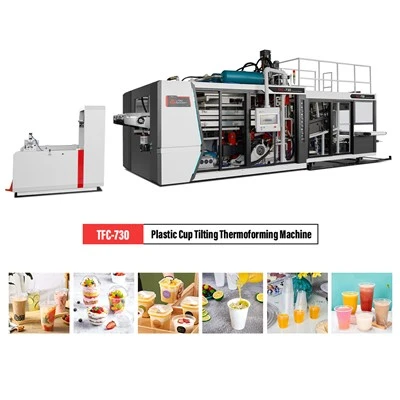
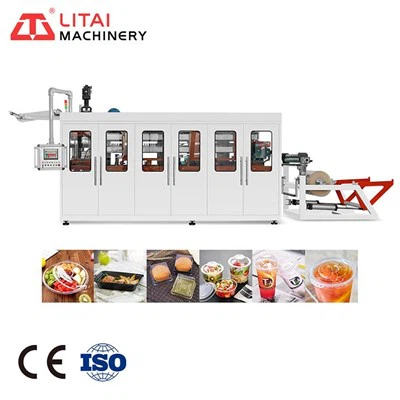
As a widely applied processing technology in modern manufacturing, Plastic thermoforming relies on precise control of heating and pressure parameters to transform plastic sheets into three-dimensional structures that meet design requirements. The reasonable setting of heating time and pressure parameters directly influences product quality, production efficiency, equipment lifespan and energy consumption. The optimization strategies of heating time and pressure parameters is systematically expounded in this paper from four aspects: process principle, material characteristics, equipment type and operation specification.
Core Logic for Setting Heating Time
1.1 Material Characteristics Determine Basic Parameters
Different plastic materials have significant differences in thermal conductivity, melting temperature ranges and crystallinity, so they need to be customized according to heating time. For example:
PVC materials: Normal PVC typically has a molding temperature range of 120-130 degrees Celsius, while high-gloss PVC requires a lower temperature range of 110 °C – 120 to prevent gloss. heating time need to be adjusted to the thickness of the sheet: 0.5mm thick sheets typically require about 30 seconds to a preheating time, and 1.5mm thick sheets take up to 60 seconds longer.
PET Materials: Their crystalline properties require precise control of heating time. If the dwell time is too long (more than 120 seconds, for example), the material tends to crystallize higher, leading to increased tensile strength, which reduces forming accuracy. Experiments indicate that 0.3mm thick PET plates can be heated at 160°C for 45 seconds to achieve optimal stretchability.
Polypropylene Material: Polypropylene is an amorphous structure that is not sensitive to heating time, but care needs to be taken to avoid overheating and decomposition. In a typical process, a 1mm thick polypropylene sheet can be heated at 180°C for 30 seconds to meet forming requirements.
1.2 Equipment Types Influence Heating Efficiency
Changes in heating methods directly affect energy transfer efficiency:
Infrared Heating: Radiant heat transfer for thin plates (<1 mm). The heating time must be adjusted according to the distance between the radiator and the plate. For every additional 10mm of distance, for example, the heating takes 15% longer.
Ceramic water heater: Thermocouple for closed-loop temperature control, heating speed than traditional quartz heaters 30% faster. For example, ILLIG machines with temperature-adjustable radiant heaters can reach rated temperatures in less than five seconds, greatly reducing preheating time.
Convection Heating: Employing hot air circulation heat transfer for thick plates (>2mm). Sufficient air duct space must be reserved to ensure temperature uniformity. Experimental data show that the 3mm thick ABS plate required to be heated in a convection oven for 120 seconds to reach a molding temperature of 180°C.
1.3 Dynamic Adjustment Strategies
Temperature Compensation mechanism: For every 10°C drop in ambient temperature, heating time is extended by 5%–10%. For example, when winter workshop temperature drop from 25°C to 15°C, the heating time of a 0.8mm thick PS plate should be increased from 40 seconds to 44 seconds.
Online Monitoring Systems: using Infrared thermometers to monitor the surface temperature of the plate in real time, PLC control system automatically calibrate heating time. One enterprise implemented the technology and the product defect rate fell from 8 percent to 2 percent.
Scientific Methods for Setting Pressure Parameters
2.1 Types of Pressure and Their Application Stages
Pressure during thermoforming is divided into positive pressure and negative pressure, which need to be controlled in stages:
Negative pressure phase (Vacuum Drawing): rapidly removes air between the plate and die to create a vacuum environment. Typical parameters range from 0.7 bar to 0.8 bar and last 8 seconds. Insufficient pressure can lead to bubble defects, such as negative pressure, which can increase scrap rate by up to 15%.
Positive pressure stage (Mold Closing and pressurized): The pressure plate is consistent with the mold cavity and the pressure range is between 3.8 and 4.2 bar. Insufficient pressure results can lead to incomplete fillings, while excessive pressure can lead to sheet rupture. Experiments show that at 4.0 bar pressure, the 1.2-mm thick PC plate achieves optimal forming effect.
2.2 Control of Pressure Loading Rate
Pressure loading should follow the principle of "fast before slow":
Initial Stage (0–50% pressure): Load at maximum speed to quickly eliminate gaps between plate and die. For example, some devices raise the pressure from 0 to 2.0 bar in the first 3 seconds.
Intermediate Stage (50%–90% pressure): loading rate reduced to 0.5 bar/s to avoid local overstretching of the plate.
Final Pressure Stage (90%–100% pressure): Maintain a fine-tuning rate of 0.2 bar/s to ensure uniform distribution of pressure.
2.3 Synergistic Optimization of Pressure and Temperature
High-temperature, low-pressure process: suitable for low-density LDPE other highly flowable materials. Applying a pressure of 3.0 bar at 150°C reduces flash defects and reduces energy consumption by 12%.
Low temperature and high pressure treatment: Applicable for PC and other high hardness materials. Product size accuracy increased by 0.05 mm at 120°C using a pressure of 4.5 bar.
Gradient Pressure Control: Multi-stage pressure settings adapt to complex structures. For example, in shaping the interior of a car, the first stage applies 3.0 bar of pressure-filled body and the second stage uses 4.2 bar of pressure-enhanced edge detail.
3. Analysis of Typical Process Cases
3.1 Forming of Food Packaging Containers
Material: 0.3 mm thick APET sheet;
Heating Parameters:
Temperature: 165 (segmented control: 170C above, 165C central, 160C below)
Time: 40 seconds (including a 10-second temperature stabilization period)
Pressure Parameters:
Negative pressure: 0.75 bar for 8 seconds
Positive pressure: 3.9 bar, load in three stages (2.0 bar/3 seconds → 3.5 bar/2 seconds → 3.9 bar/1 sec)
Results: The the product's wall thickness uniformity increased by 18% and the production efficiency reached 450 pieces per hour.
3.2 Forming of Automotive Interior Parts
Material: 2.0mm thick ABS+PC alloy sheet
Heating Parameters:
Temperature: 190°C (convection heating)
Time: 150 seconds (including 30 seconds of heat penetration)
Pressure Parameters:
Negative pressure: 0.8 bar for 10 seconds.
Positive pressure: 4.5 bar, load in two stages (3.0 bar/5 seconds → 4.5 bar/3 seconds)
Results: The product's surface gloss of the product reached 92 GU and dimension stability ± 0.1 mm.
Operational Norms and Safety Guarantees
4.1 Standardized Operational Procedures
Parameter Recording: Establish a process database to record the most optimal combination of parameters for different materials and products. One enterprise reduced the mold adjustment time by 40%.
Equipment Inspection: Check heating elements, pressure sensors and safety valves daily before starting the engine to ensure that the error between the displayed parameters and actual parameters is less than 5%.
Training of personnel: Operators must pass theoretical exams (including material science and equipment principles) and practical assessments (completion of three typical product prototypes) before they can take up positions.
4.2 Safety Protection Mechanisms
Overpressure Protection: setting up a two-stage alarm system. Sound and visual alarms are triggered when the pressure exceeds the set value of 10%, and the machine automatically stops when the pressure exceeds 15%.
Temperature Monitoring: use of a temperature measuring system of more than three degrees (infrared + thermocouple + PT100). If the sensor is abnormal, the heating power should be cut off immediately.
Emergency response: Install a manual pressure relief valves and emergency stop button on the machine to ensure that the operator can terminate the operation of the machine in 2 seconds.
5. Future Technological Development Trends
5.1 Intelligent Control Systems
AI Algorithm Optimization: Analyzing historical production data with machine learning to automatically generate optimal parameter combinations. After implementation, the product qualification rate one enterprise increased to 99.2%.
Digital Twin Technology: set up a virtual forming model, forecast the effect of parameter adjustment in advance, reduce the number of mold trials by more than 50%.
5.2 Green Manufacturing Technologies
Energy Recovery Systems: Recovery of waste heat from heating stage, preheating of sheet metal, reducing energy consumption by 15%–20%.
Lightweight Design: Adopt carbon fiber die and servo press to reduce inertia of equipment and achieve precise pressure control.
Conclusion
The determination of heating time and pressure parameters of plastic thermoforming machines is a systematic engineering which requires to take into account material characteristics, equipment performance, product structure and environmental factors. Through scientific setting parameters, strict adherence to operating norms and continuous pursuit of technological innovation, enterprises can significantly improve product quality and efficiency while reducing operating costs and environmental impact. In the future, with the further application of intelligent manufacturing technology, thermoforming processes will develop in the direction of higher automation and refinement, providing key support for manufacturing transformation and upgrading.