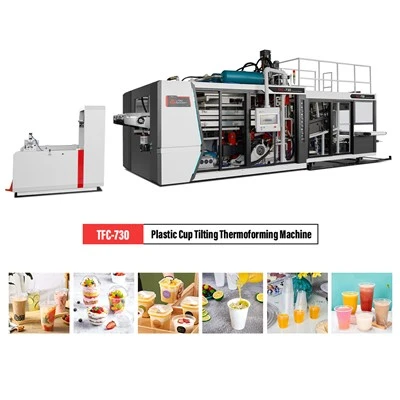
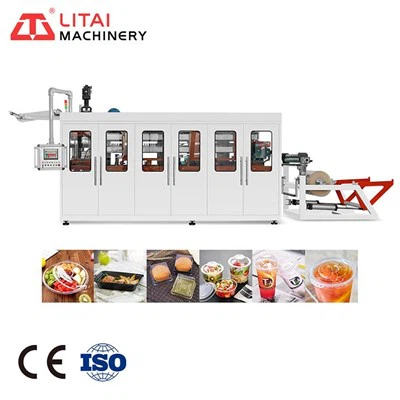
In today's fast-moving consumer market, plastic cups are used a lot in places like restaurants, homes, and offices. This is because they are easy to use, clean, and cheap. As the main tool for making plastic cups, the production speed of the Plastic Cup Manufacturing Machine directly affects a company's output, cost control, and market strength.Accurately calculating how fast the machine works helps companies plan production well, use resources better, and make more money. This paper will discuss in detail the calculation methods, influencing factors and improvement strategies of the production efficiency of Plastic Cup Manufacturing Machine.
Basic concept of efficiency of Plastic Cup Manufacturing Machine
Productivity refers to the ratio of the quantity of qualified products produced per unit of time to the input resources (such as labor, equipment, raw materials, etc.). For Plastic Cup Manufacturing Machine, production speed mainly shows how many good cups the machine can make in a set time. This number not only shows what the machine can do, but also includes how different things affect production.
Calculation Indicators Production Efficiency
Theoretical Production Efficiency
Theoretical production speed means how many plastic cups a Plastic Cup Manufacturing Machine can make in a set time under perfect conditions. This mostly depends on the machine's rated speed and the time it takes to make one cup. Production cycle refers to the time it requires to produce qualified plastic cups from the input of raw materials to injection molding, cooling and removal.
calculation formula: Theoretical production efficiency (pieces perhour) = 3600 plastic cups production cycle (seconds)
For example, if a plastic cup has a production cycle of 10 seconds, the theoretical production efficiency is 3600 ÷ 10 = 360 pieces perhour. Theoretical production efficiency is an ideal value in equipment design and provides a reference benchmark for practical production, but it is difficult to realize in practical production.
Actual Production Efficiency
Actual production efficiency refers to the quantity of qualified plastic cups produced per unit of time in actual production process of plastic cup production equipment. It takes into account the equipment downtime, the failure time, the time of mold replacement and other non-production time which affects production.
calculation formula: actual production efficiency (pieces perhour) = actual quantity of qualified plastic cups produced
Actual production time refers to the effective production time after equipment downtime, malfunction, mold changes and other non-production time. For example, if the equipment is down for 10 minutes due to a malfunction, it takes 15 minutes to replace the mould in an hour, and the actual production time is 35 minutes (i.e. 35-60 hours). If 200 qualified plastic cups are actually produced, the actual production efficiency is 200 ÷ (35,160) ≤ 342.86 pieces/hour.
Overall Equipment Effectiveness (OEE)
Overall Equipment Effectiveness is a comprehensive index to measure the production efficiency of plastic cup manufacturing machinery. Three factors are considered: equipment utilization rate, performance utilization rate and product conformity rate.
Usability: indicates the percentage of time that the equipment will be up and operating within the planned production time.
calculation formula: usability = actual running time * planned production time * 100%
Performance rate: Reflects the speed efficiency of the equipment in actual operation, that is, the ratio of actual production speed to theoretical production speed.
calculation formula is: performance rate = (Actual production quantity × Theoretical production cycle) * actual running time * 100%
Qualified Product Rate: refers to the number of qualified plastic cups produced and the total number of plastic cups produced ratio.
calculation formula: Qualified product rate = number of qualified plastic cups = total number of plastic cups produced * 100%
Overall Equipment Effectiveness (OEE) formula is: OEE = Availability × Performance rate × Qualified product rate × 100%
For example, a plastic cup making machine has a planned production time of 8 hours and an actual run time of 7 hours, so availability is 7 ÷ 8 × 100% = 87.5%. Theoretical production cycle is 10 seconds, actual production quantity is 2000 pieces, actual operation time is 7 hours (25200 seconds) and performance is 2000 × 1,025,200 × 100% ≤ 79.37%. The total number of plastic cups produced is 2100, and the number of qualified plastic cups is 2000, with a pass rate of 2000 ÷ 2100 × 100% ≤ 95.24%. Then OEE = 87.5% × 79.37% × 95.24% ≤ 65.7%.
Factors affecting Production Efficiency
Equipment Factors
Equipment Performance: The performance of plastic cup manufacturing machinery directly affects production efficiency. Advanced equipment has higher injection molding speed, more accurate temperature control, more stable operation performance, can shorten the production cycle and improve production speed. For example, equipment using speed injection molding technology can complete injection molding and cooling in a relatively short period of time, thus increasing the output per unit of time.
Equipment maintenance: Regular maintenance and repair of equipment is the key to ensure the normal operation of the equipment.If the machine is not well maintained, it breaks down easily. This leads to more stop time and lower production speed. For example, a worn mold hurts both the quality and the speed of making cups. Replacing a worn mold on time stops production from being interrupted by quality problems.
The level of machine automation also matters. Machines with high automation cut down on manual work. They make production more steady and non-stop. For example, automatic material feeding, automatic mold release, and automatic check systems reduce the need for people to step in. This also lowers the effect of human mistakes on production speed.
Raw material factor
Raw Material Quality: High quality raw material can guarantee the quality and stability of plastic cups. If the raw material quality is poor, it is easy to appear bubbles, cracks and other injection molding defects, increasing scrap rate and reducing production efficiency. For example, the use of raw materials containing impurities can cause mold blockages and affect the continuity of production.
Raw Material Supply: A steady flow of raw materials is the base for smooth production. If raw materials do not arrive on time, the machine stops for loading, and production speed drops. The company should build good ties with suppliers to make sure raw materials come on time.
Process factors
The temperature, pressure, speed of injection molding parameters set, directly affect the quality and speed of injection molding. A good process setting will help the cup form, reduce scrap rate and increase production speed. For example, if the molding temperature is too high, plastic may decompose, smell or change color. This will affect quality of the product. If the molding temperature is too low, plastic does not flow well, and some parts may not fill right.
Mold Design: Mold design also has an important impact on the efficiency and quality of plastic cups. A good mold design can shorten the time to make each cup. It helps cups come out of the mold faster and lowers the number of bad cups. For example, multi-cavity molds can make many cups at once. This raises the output in a set time.
Human Factor
The skill level of the operator directly affects how well the machine runs and the quality of the cups. Skilled workers can set process parameters the right way. They can also fix production problems quickly. This cuts down stop time and raises production speed. Companies should train their workers more. This helps improve their skills and hands-on experience.
Personnel management: Reasonable personnel arrangement and management can improve productivity. For example, the use shift system system can ensure the continuous operation of equipment and improve the utilization of equipment. The establishment of effective incentive mechanism can arouse the work enthusiasm and initiative of operators and improve production efficiency.
Strategies to improve Production Efficiency
Optimize Equipment Management.
Periodic maintenance: Make a clear equipment maintenance plan to check, clean, oil, and change worn parts on time so the equipment works well.
Equipment upgrade: upgrade old equipment based on production needs and new technology to make equipment work better and more automatic.
For example, the installation of intelligent monitoring system can monitor the running status of devices in real time, detect and solve problems in time, and reduce downtime.
Optimize Raw Material Management
Strict quality control: strengthen quality inspection of raw materials to make sure they meet production needs. Work with good suppliers for a long time to keep raw material supply and quality stable.
Optimization of stock management: Reasonable control of raw material inventory to avoid production interruptions due to excessive stock occupation and insufficient stock. Adopt advanced inventory management system, monitor raw material inventory in real time and replenish stock in time.
Optimize Process Parameters
Process testing and optimization: Process testing to find good injection molding settings such as temperature, pressure and speed. This helps make plastic cups work better and faster.
Adopting advanced technology: focusing on the adoption of industry-advanced technology, such as runner technology, gas-assisted injection molding technology, and timely introduction and application in production, to improve production efficiency and product quality.
Strengthening staff training and management
Skill training: Hold regular skill training for operators. This helps them get better at running the machine, setting process parameters, and fixing problems.
Performance appraisal: to establish a scientific and reasonable performance appraisal system, linking production efficiency, product quality and other indicators with the operators' salaries, motivating operators to work and improving production efficiency.
Conclusion
The production efficiency of plastic cup production machinery is an important index of enterprise production management. Accurate calculation of production efficiency and analysis of its influencing factors are of great significance for enterprises to improve production capacity, reduce costs and enhance market competitiveness. By strengthening equipment management, raw material control, process setting, worker training and other measures, to improve the production speed of cup maker. This helps businesses in the long run. In real production, companies should make specific plans based on their own situation. They should keep making production management better. This raises both the machine's output and the company's profits.