Against the background of rapid development of the plastic packaging industry, technological advancements in plastic cup manufacturing machine equipment are profoundly reshaping production efficiency and product quality. As a mainstream solution in the industry, automatic and semi-automatic plastic cup production equipment in automation levels, production efficiency, operating complexity and cost structure, and so on, there are significant differences. This paper discusses these disparities from four dimensions: technical principle, production process, application scenarios and economic feasibility.
1. The Difference between Technology Principle and Automation Architecture
1.1 Integrated Control Systems for fully automated machinery
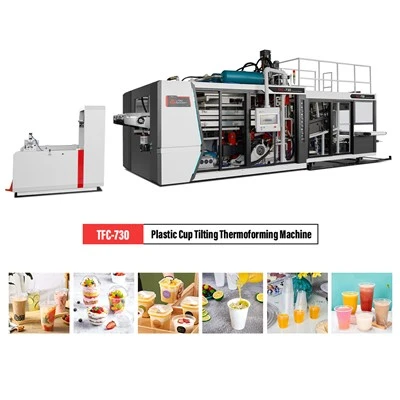
The automatic plastic cup manufacturing machine takes PLC (Programmable Logic Controller) as its core, which consists of servo drive systems, infrared heating modules and multi-station robot arm. Their workflow consists of six stages: automatic sheet feeding, uniform infrared heating, pneumatic forming, laser cutting, waste recycling and intelligent stacking. All operations are coordinated by a central control system. For example, some models utilize 12 servo motors to precisely control the opening/closing speeds of the die, with bidirectional stroke adjustment capabilities for a 0.01mm forming accuracy.
In temperature management, fully automated machinery provides intelligent compensation algorithms through a three-zone up-and-down hot air circulation that maintains the softening temperature of PP plates within 160°C ±2°C. Studies have indicated that this temperature control method can reduce the failure rate of semi-automatic systems from 8% to below 0.5%.
1.2 Segmentation of Semi-Automatic Machines
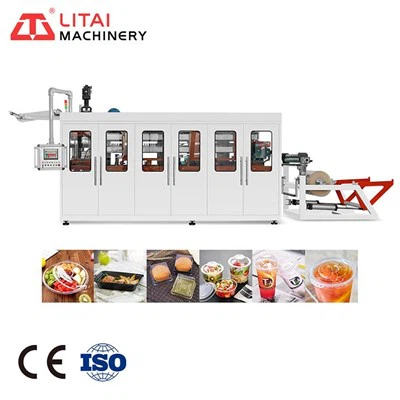
Semi-automatic machines usually combines relay controls with hydraulic drive, dividing production into four discrete steps: manual sheet feeding, mechanical mold closing, pneumatic forming and mechanical cutting. In a typical model, the operator manually feeds 380mm-wide PS sheets into the heating zone and triggers mold to close with foot pedal when the temperature reaches 140°C. This segmentation approach results in overall device Effectiveness (OEE) being 40-60% lower than in fully automated models.
Semi-automatic cutter mainly uses circular blade, the accuracy depends on the stability of paper feed. Field measurements show that the cup rim size varied by ±1.2mm during continuous production, while fully automated laser cutting maintains ±0.3mm accuracy.
2. Production Efficiency and Capacity Comparison
2.1 Industrial scale Capacity of fully automated machinery
Modern fully automated machines are designed with multiple turrets, and certain 12-station models have theoretical output of 120 cycles per minute (based on a 90mm diameter cold drink cup). With a modular design, the machines support rapid mold changes with full-size covers ranging from 50ml jelly cups to 1,000ml fast-food containers. More than 85 per cent of the 24 hours of operation were completed, with a single-line capacity of over 172,800 pieces day.
2.2 Flexible Production Characteristics of Semi-Automatic Machines
Although semi-autonomous machines theoretically have a production cycle of 8-15 weeks/minute (significantly less than fully automated machines), they require only 30-50% of the investment cost. They have demonstrated a unique advantage when it comes to small, bespoke production: one small and medium-sized business produces 50,000 irregular coffee cups in 24 hour shifts using three semi-automated machines that take less than 20 minutes to mold change.
A comparison of energy consumption reveals that fully automated machinery can reduce energy consumption per unit by 25% to 35% through servo drives and energy recovery systems. For a production line with an annual output of 100 million units, approximately 120,000 kWh of electricity could be saved each year.
3. Operational Complexity and Labor Requirements
3.1 Intelligent interfaces in fully automated machinery
Modern fully automated machines have 10-inch touchscreens. These screens put together production monitoring, fault diagnosis, and remote maintenance. Operators can change 12 main parameters (like heating temperature and molding pressure) using HMI interfaces. They can also save 20 process recipes. Operators require only 40 hours of training to independently manage the entire production cycles, according to manufacturer data.
In terms of maintenance, modular design can quickly replace key components such as servo motors and heating elements. Some models of self-diagnostics offer a 48-hour advance warnings of component failures, limiting downtime to less than 12 hours a year.
3.2 Skill Dependency of Semi-Automatic Machines
Semi-automatic machines require much higher technical requirements for operation and require people who are proficient in mechanical regulation and process control. Temperature management, for example, necessitates manual adjustment of heating power based on ambient humidity --in summer, polypropylene sheet softening time can vary ±5 seconds, directly affecting the uniformity of wall thickness uniformity.
The manual configuration of semi-automated production lines typically requires 3-4 workers: one for sheet feeding, one for molding operations, one for quality inspection and one for waste disposal. With a production capacity of 50,000 units per day, fully automated systems require only one operator and one packer, reducing labor costs by 60-70%.
4. Application Scenarios and ROI Analysis
4.1 Scalable Applications of Fully Automated Machinery
Fully automated machinery is good for standardized production. The yearly demand is over 50 million units. One big food service chain set up four fully automated production lines. These lines make six kinds of coffee cups and containers. This cut unit cost by 32% compared to outsourcing. It also cut delivery time from 15 days to 72 hours.
For environmental use, these machines work very well with biodegradable materials like PLA. By improving heating curves, the shrinkage of some PLA parts dropped from 3.5% to 1.2%. This makes the product meet EN13432 degradability standards. It also helps sell the product in the European market.
4.2 Differentiated Niche of Semi-Automatic Machines
Semi-autonomous machinery has superior ROI for custom products with an annual demand of less than 5 million units. A design studio has used two semi-automatic machines to develop 12 limited-edition art coffee cups, tripling the price of standard products and generating an annual profit of more than $280,000.
Semi-autonomous machinery holds obvious advantages in terms of lifecycle costs. Over five years, depreciation of equipment accounted for 45% of total ownership costs of fully automated systems (TCO), while labor costs of semi-automated alternatives accounted for only 30% of TCO. In labour-intensive areas, this differential in cost structure reverses investment decisions.
5. Technological Trends and Industry Impact
Industry 4.0 is driving two key growth paths: fully automated machines are advancing toward intelligence and flexibility, and new machine vision systems integrate real-time defect detection and automatic cutting parameter adjustments. At the same time, semi-autonomous machinery has become more competitive through one manufacturer's "semi-automatic+" solution boosts efficiency improves efficiency by 40% through automated feeding modules, while maintaining investment flexibility.
In terms of industry impact, the popularity of fully automated machines is reshaping market dynamics. The study predicts that these systems will achieve a market penetration of 65% in plastic cup manufacturing machine sector by 2028, driving industry consolidation. Semi-automatic machines will focus on premium customization and emergency production niches, creating a differentiated competitive ecosystem.
Conclusion:
The difference between fully automatic and semi-automatic plastic cup manufacturing machine technology represents essentially a collision of industrial-scale production and flexible manufacturing paradigms. For big and standard jobs, fully automated systems are best because they work faster and more steadily. Semi-automatic machines are still useful because they are flexible and cost less for custom jobs and small batches. With better materials and control technology, the technical differences between these types will keep getting smaller. Then the industry will have a setup of "fully automated, with semi-automated for special support."