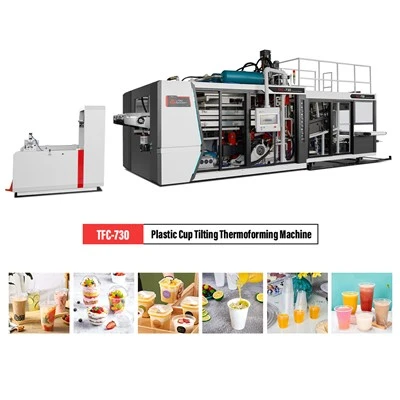
plastic cups, which are widely used in daily life, occupy an important position in various scenarios such as dining, household and office due to their lightweight, durable and economical properties. Plastic cup manufacturing machinery as the core equipment of plastic cup production, its working principle involves multiple complex engineering fields such as materials science, mechanical engineering and thermodynamics. This paper talks about how plastic cup making machines work. It covers the whole process from raw material prep to finished cup output.

Raw Material Preparation
Raw material prep: Plastic cups are made from plastic pellets. Common types are PP, PE and PS. These particles have different properties. PP, for example, is heat and chemical resistant. PE is very flexible and works well in cold. PS is clear and easy to shape. When selecting raw materials, the expected use, performance requirements and cost of plastic cups need to be taken into account.
Plastic particles need to be pretreated before they can be put into production. First, the particles must be dried to remove any moisture they may contain. This is because moisture can degrade plastics during high temperature processing, affecting product quality and leading to defects such as bubbles and cracks. Drying treatment usually uses a hot air circulation dryer, which dries plastic particles for several hours at a certain temperature, reducing their moisture content to a prescribed range.
Secondly, in order to improve the properties of plastics or to give them a specific color, various additives and pigments need to be added to plastic particles. Plastic additives include plasticizers, stabilizers, and lubricants. Plasticizers make plastic more flexible. Stabilizers stop it from getting old. Lubricants help it flow better in processing. Pigments are used to color plastic cups. This meets different market needs. After adding these things, the plastic pellets must be mixed well. This makes sure all ingredients spread evenly. This mixing process is usually done in a blender.
Plastic Melting and Plasticizing
The pre-treated plastic pellets are loaded into the hopper of the plastic cup manufacturing machine and sent to the heating cylinder continuously and uniformly through the screw feeder. Inside the barrel is a screw that rotates under the motor while moving in an axial direction. The structure of screw is specially designed and divided into three sections: feeding section, compression section and the metering section.
In the feeding section, the screw grooves is relatively deep, and its main function is to transport plastic particles smoothly from the hopper to the compression section. As the screw rotates, the plastic particles gradually tighten in the screw grooves, draining the air inside. When entering the compression section, the depth of the screw grooves decreases gradually, and the compression effect of the screw on the plastic particles increases. At the same time, the heating device outside the barrel starts working and heats the plastic. Under the combined action of the screw's rotation, compression and external heating, the plastic particles gradually melt from solid to viscous flow.
The function of the measuring segment is to ensure that molten plastic is delivered to the die at a steady flow and pressure. The depth of the screw grooves in this section remains the same. The output of molten plastic can be adjusted by precisely controlling the speed of the screw. At the same time, a number of temperature sensors are installed on the cylinder to monitor the temperature at different locations in real time and to feed the signal back to the control system. The control system changes the heating power based on a set temperature curve. This keeps the plastic at the right temperature and fluidity during the whole plasticization process.
Injection Molding
When the molten plastic in the drum reaches an appropriate state, the screw is driven by the hydraulic system to inject the molten plastic into the closed mold cavity at high pressure and speed. Mould is one of the key components of plastic cup manufacturing machine, which determines the shape, size and appearance quality of plastic cup. The mold is usually composed of a movable mold and a fixed mold, which can be opened and closed by the hydraulic system.
Mold cavity design is extremely precise and needs to be processed according to the final shape of the plastic cup. During injection process, molten plastic quickly fills the cavity. Due to relatively high viscosity of plastic, some resistance will be encountered during filling. Parameters such as injection pressure, injection speed, and injection time need to be precisely controlled to ensure the plastic can fully fill the cavity and avoid defects such as short shots and weld lines.
Injection pressure is the pressure of pushing molten plastic into cavities with screws, and its size directly affects the filling capacity and product density. The speed of injection determines the flow state of the plastic in the cavity. Too high injection speed can cause turbulence and bubbles in the cavity; too slow injection speed can cause the plastic to cool and solidify during the filling process, and the cavity cannot be filled completely. Injection time is the time interval from the start of injection to the end of injection. It is related to the speed of injection and the volume of the cavity.
Cooling and Curing
When the melted plastic fills the whole mold, it needs time to cool and harden. It changes from a thick liquid to a solid. This keeps the shape and size of the plastic cup. The cooling process uses water channels inside the mold. Cool water runs through them and takes heat away from the mold and the plastic.
How long cooling takes depends on the plastic type, the mold temperature, and the cup thickness. If cooling time is too short, the cup may not harden fully before coming out. Then it can bend or lose shape. If cooling time is too long, the machine works slower. This raises the cost to make each cup. So we need to control the cooling time exactly based on the real situation. During the cooling process, the mold temperature also needs to be relatively stable, and the flow rate and temperature of cooling water need to be regulated by temperature control system to ensure that the mold temperature is in the appropriate range.
Demolding and Reprocessing
When the plastic cup is completely cooled and solidified in the mold, the moving mold is separated from the fixed mold by a hydraulic system, while the ejection mechanism pushes the plastic cup out of the mold. The ejection mechanism is usually composed of ejector pins and an ejector plate. Through reasonable structural design, ensure that the plastic cups can be removed smoothly and not damaged.
Plastic cups may still have surface defects such as burrs and flash after removal and need to be reprocessed. Post-treatment techniques include trimming, grinding and polishing. Through these processes, the surface flaws of plastic cups can be eliminated and the appearance quality of plastic cups can be improved. In addition, in order to improve the surface performance of plastic cups, such as printing adhesion and glossiness, plastic cups can also be treated with corona treatment and coating treatment.
Quality Control
Quality control is the key link throughout the plastic cup manufacturing process. In order to ensure that the plastic cups produced conform to the relevant standards and customer requirements, a variety of detection methods are used to test quality of the products. Common inspection items include appearance quality, dimension accuracy and physical performance.
Appearance quality check uses sight and optical tools. Check the surface of the plastic cup for scratches, cracks, bubbles or colour changes. Size accuracy checks use tools like calipers, micrometers, and projectors. These measure the cup's diameter, height, and wall thickness. This makes sure the cup meets design needs. Physical tests include checks for tensile strength, impact strength, and heat resistance. Special test tools are used to measure these physical traits of plastic cups. A well-designed plastic cup making machine helps meet these quality standards every time.
Conclusion:
The working principle of plastic cup manufacturing machine is a complex process involving multiple links. Precise control and good teamwork are required at every step, from the preparation of the raw materials to the output of the finished cup. Choose the right raw material, control the plasticization step, set up the injection molding settings correctly, do a good job of cooling and hardening, and perform strict quality checks, so that the plastic cups can be produced successfully. With the development of science and technology, the plastic cup manufacturing machine is in constant development. Automation is on the rise. Production speed and quality are improving. In the future, these machines will continue to move in an intelligent, fast, green direction. This will make people's lives easier.