

Plastic thermoforming technology is widely used in fields of food packaging, daily products, automobile interior, etc.. The process involves heating and softening thermoplastic plastic sheets, then using vacuum or air pressure to bring them into line with mold cavity, before cooling and shaping them into finished products. However, the molecular structure, thermal properties and processing characteristics of different plastic materials exist very different, so the parameters of thermoforming process parameters need to be adjusted. In this paper, the differences of core parameters such as temperature, pressure, time and mold design in different plastics production processes are systematically analyzed.
Temperature Parameters: Precise Control Based on Material Thermal Properties
Temperature is one of the most critical variables in the thermoforming process, which directly influences the softening degree, fluidity and forming quality of sheet metal. Different plastics have distinct glass transition temperatures (Tg), melting temperatures (Tm) and decomposition temperatures, which require precise control through periodic heating.
1.1 Heating Temperature range
Polystyrene: (PS, as a common food packaging material, is usually formed at temperatures between 120 and 180 degrees Celsius. Due to its low thermal conductivity, double-sided heating or extended heating times (approximately 15–30 seconds) is required to ensure uniform softening of the plate. PS breaks down easily, causing bubbles or discoloration if the temperature exceeds 190°C; conversely, inadequate temperature results in inadequate stretching of the the finished product and uneven wall thickness.
Polypropylene (PP): Polypropylene has a high melting point (around 160-170°C) and a molding temperature range of 180-220°C. It has better heat resistance than PS, but is less liquid and requires a higher mold temperatures (40–70°C) to improve mold filling. For example, in the production of polypropylene medicine bottles, mold temperature must be controlled above 60°C to reduce internal stress.
Polycarbonate: Polycarbonate has a narrow temperature range (140–200°C) and a high temperature uniformity requirement. If the local temperature exceeds 220°C, PC will undergo thermal degradation, resulting in brittleness of the the finished product; insufficient temperature will lead to "cold spot" defects. Infrared heating and temperature feedback systems are required for the production of PC glasses to ensure a surface temperature difference of less than 5°C.
1.2 Heating time control
Heating time is positively correlated with sheet thickness. For boards 0.5 mm thick:
PS: Heat for about 10-15 seconds to avoid overheating and sag.
PP: Due to its low thermal conductivity, heating time needs to be extended to 20–25 seconds.
High Density Polyethylene (HDPE): Heating can take more than 30 seconds and requires a phased heating (gradually increasing from 80°C to 180°C) to prevent deformation.
Pressure Parameters: Balanced Forming Power and Product Accuracy
Pressure parameters, including vacuum level, air pressure and mold clamping force, directly affect mold filling effect, wall thickness uniformity and the finished product surface quality.
2.1 Differences between Vacuum Forming and Air Pressure Forming
Vacuum Forming: Negative pressure (typically ≥0.08 MPa) is caused by a vacuum pump pulling the sheet into the mold, suitable for simple thin wall products such as lunch boxes. Polystyrene has good mobility and requires a vacuum level of 0.08–0.1 MPa, while PC requires a higher vacuum (0.12–0.15 MPa) due to high viscosity to overcome resistance.
Air Pressure Forming: Compressed air (0.3–0.5 MPa) is used to press plates into molds for deep cavities or composite structures (e.g. car instrument panels). Polypropylene requires a pressure of over 0.4 MPa under air pressure to ensure adequate filling of the sidewalls; HDPE, due to poor mobility, necessitates the use of pressure aids to prepull the plate.
2.2 Optimization of Mold Clamping Force
The mold clamping force must be adjusted according to the ductility of the material:
PS: moderate ductility, 5 5 – 10 tons square meter of a clamping force.
PP: Due to its high crystallinity and poor ductility, the clamping force must be increased to 15–20 tons per square metre to prevent rebound.
Thermoplastic elastomer: As a highly ductile material, the clamping force should be reduced to 3–5 tons per square meter to avoid product overcompression and thinning.
Time Parameters: Balancing Cycle Efficiency and Mass
Time parameters include heating time, molding time, cooling time, removal time, etc.. The production efficiency must be improved while ensuring quality.
3.1 Cooling Time Control
Cooling time accounts for over 60% of the molding cycle, which directly affects the size stability of the finished product:
PS: Cool for approximately 5–10 seconds and use water-cooled die to speed up solidification.
PC: Because of its high thermal shrinkage rate (0.5–0.7%), the cooling time needs to be extended to 20–30 seconds and a phased cooling (gradual reduction from 80°C to room temperature) is required to reduce internal stress.
PP: The cooldown is about 15-20 seconds, and insufficient cooling can lead to deformation after removal.
3.2 Optimization of commissioning time.
The demolding time shall be adjusted according to the adhesion between the material and the die:
PS: The demolding time is short (1-2 seconds) and can be quickly removed with a robotic arm.
PC: Due to the hardness of the surface, the demolding time needs to be extended to 3–5 seconds to prevent adhesion.
TPE: As a soft material, a mold release agent must be applied and the removal time must be limited to 2–3 seconds.
Mold Design Parameters: Structural Adaptation and Functional Realization
Mold design must combine material characteristics and product shape, with a focus on optimizing hole layout, cavity dimensions and surface roughness.
4.1 Vent Hole Design
The diameter of vent holes shall be adjusted according to the thickness of the plate:
PS (0.5 mm thk): vents 0.3 – 0.5 mm in diameter and spaced 20 – 30 mm apart.
PP (1.0 mm thk): Ventilation holes 0.6 – 0.8 mm in diameter and spaced 30 – 40 mm apart.
PC (2.0 mm thk): vents 1.0 – 1.2 mm in diameter and spaced 40 – 50 mm apart.
4.2 Cavity Dimension Compensation
The shrinkage of the material is an important basis for mold design:
PS: shrinkage rate is approximately 0.4–0.8% and cavity dimensions should be 0.5% -1.0% larger than the finished product.
PP: shrinkage rate 1.0 – 2.5% and cavity dimensions should be larger than 1.5 – 3.0%.
PC: shrinkage rate 0.5 – 0.7% and cavity dimensions should be larger than 0.8 – 1.2%.
4.3 Surface Roughness Control
The surface roughness of the die affects the disassembly performance and appearance quality of the finished product:
PS: Surface roughness ≤ 0.8 micron, sandblasted to improve ventilation efficiency.
PC: Surface roughness shall Ra ≤ 0.4 μm and shall be polished to a mirrored surface to reduce scratches.
TPE: Surface roughness should ≤ 3.2 μm, with a certain texture retained to enhance friction.
Typical case study: Process Adaptation of different materials
5.1 PS Lunchbox Production
Temperature: 160C heat, 30C mold temperature.
Pressure: 0.09 MPa Vacuum level with a clamping force of 8 tons / m2.
Time: 12 seconds Heating time and 8 seconds to cool.
Die: vents 0.4 mm in diameter, spaced 25 mm apart, sandblasted surface treatment.
5.2 PP Automotive Interior Parts Production
Temperature: Heat 200°C, mould 60°C.
Pressure: 0.4 MPa with a clamping force of 18 tons / m2.
Time: 22 seconds Heating time and 18 seconds to cool.
Mould: Vent hole diameter 0.7 mm, spacing 35 mm, polished surface to Ra ≤ 0.8 μm.
5.3 Production of PC Eyeglass Lenses
Temperature: 180C heat, 80C mould.
Pressure: 0.12 MPa Vacuum level with a clamping force of 12 tons / m2.
Time: 25 seconds Heating time and 25 seconds to cool.
Die: vents 1.0 mm in diameter, 45 mm spaced, hard chrome finish.
Conclusions and outlook
Differential design of plastic thermoforming process parameters is the key to ensure product quality. In the future, with the development of materials science (such as bioplastics, nanocomposites, etc.) and the popularization of intelligent manufacturing technologies (such as artificial intelligence parameter optimization, real-time temperature monitoring, etc.), thermoforming processes will evolve towards higher accuracy and efficiency. Enterprises need to combine material characteristics and product requirements, establish a scientific process parameter base through experimental verification and simulation optimization to meet the challenges of diversified market.

Knowledge
Mar 30, 2026
What are the differences in process parameters when using a plastic thermoforming machine to produce different plastic products?
Send Inquiry
-
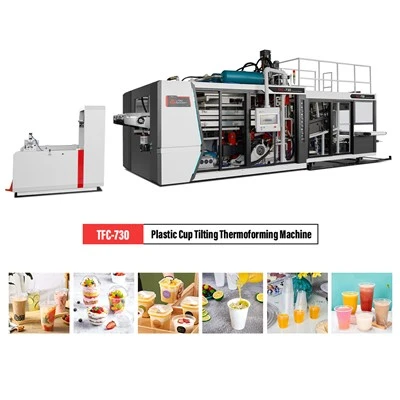
Plastic Glass Making Machine
Read More > -
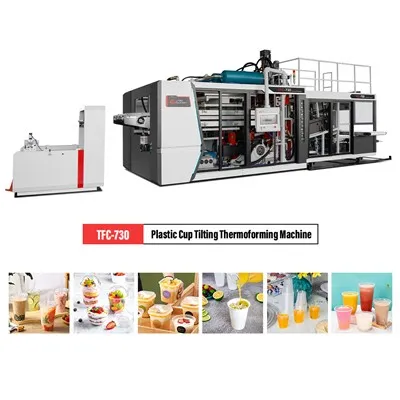
Flip Mold Plastic Thermoforming Cup Machine
Read More > -
Tilt-mold Cup Thermoforming Machine
Read More > -
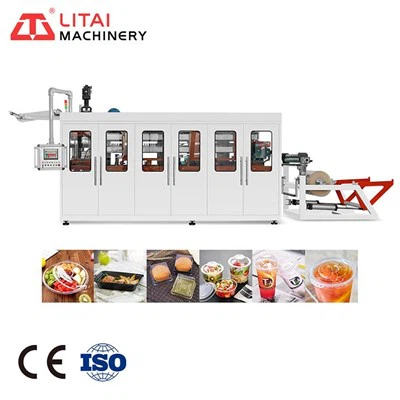
TQC-750 Plastic Cup Thermoforming Machine
Read More >