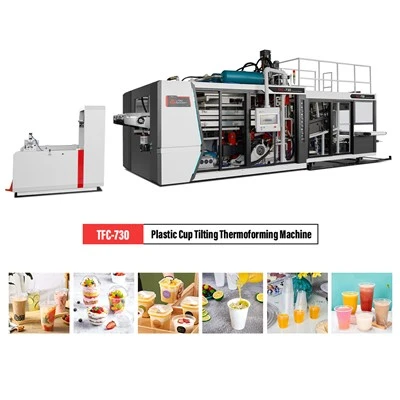
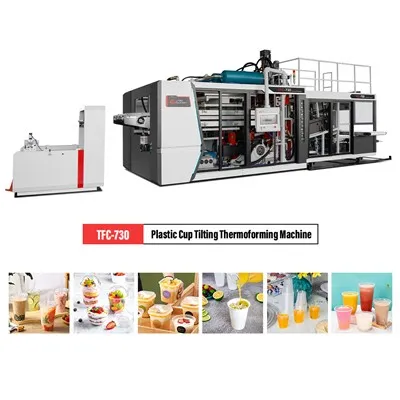
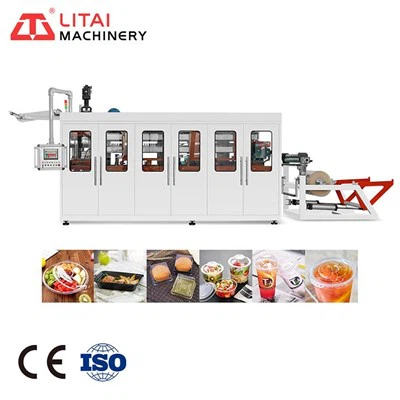
As the core technology of modern manufacturing industry, Plastic thermoforming is widely used in the fields of food packaging, medical devices, automobile components and so on. However, product deformation is still a key factor affecting quality. approximately 35% of plastic defects come from deformation issues during molding, according to industry data. By studying thermoforming machine operations and deformation mechanisms of the thermoforming machine, a comprehensive solution including equipment setup and process control is put forward systematically.
I. Critical control points in equipment preparation
1.1 Mold Installation and Calibration
Mold installation precision directly affects the stability of product size. Operators must use laser alignment to verify the coaxiality of mold locating pins and guide rod, allowing error to be controlled to ± 0.2 mmWave. For example, in the production of a specific medical tray model, optimizing the torque distribution of die fastening bolts (using diagonal step fastening) can reduce warping by 62%. Mold surfaces requires nano-scale polishing to achieve roughness Ra values ≤ 0.1 μM, effectively minimizing frictional stress during disassembly.
1.2 Heating System Debugging
The power matching of Heating element power needs to be calculated accurately according to material properties. For polypropylene materials, a segmented temperature control mode recommended: 185 185 ± 2 ° C the upper mold temperature, 178 + -2 °C for the lower module, and 5°C for the heating zone. One enterprise installed infrared temperature measurement arrays to monitor the mould's surface temperature distribution in real time, reducing product shrinkage from 1.8 per cent to 0.5 per cent. Heat conducting silicone oil should be applied between heating tube and mold surfaces to reduce heat resistance by over 40%.
1.3 Cooling System Optimization
Cooling channel layout should follow the "core cooling priority" principle. In the production of automobile interior components, the change from linear cooling channel design to spiral cooling channel design has tripled cooling efficiency. Cooling water temperature should be maintained between 15-20°C, flow rates ≥8L/min, and accurately controlled by electromagnetic flow meters. For thick-walled products, variable temperature cooling is available: 25°C circulating water is used for rapid shaping for the initial 30 seconds, followed by 15°C water for final curing.
ii. Process Parameter Control System
2.1 Material Preprocessing Specifications
Material moisture content has a great influence on deformation. Experiments show that when the moisture content of PET pellets increases from 0.3% to 0.8%, product warpage increases 2.3 times. A three-stage drying process is recommended: 2 hours 80°C, 2 hours 120°C, and then natural cooling to room temperature. Drying equipment should be equipped with a humidity sensors that automatically activates dehumidification systems when ambient humidity exceeds 60%.
2.2 Molding Cycle Optimization
The molding cycle consists of heating, pressure holding and cooling. Optimal parameters were determined by experimentally designing specific food container models: 18-second heating (mold temperature 190°C), 12-MPa 5-second pressure retention and 22-second cooling. Thus the product flatness error ≤0.15mm was achieved. Pressure-Time Curve Recorder shall monitor pressure decay during maintenance; when the attenuation exceeds 15%, the seal of the hydraulic system shall be inspected.
2.3 Multi-stage Pressure Control Technology
Three-stage pressure control significantly improves stress distribution:
Pre-compression: initial mold cavity contact 3MPa
Main compression: 15MPa after material reaches glass transition temperature
Maintain pressure: 8MPa to compensate for contraction
One enterprise adopts this technique to reduce residual stress by 58% and improve impact resistance by 22%.
III. Diagnosis and correction of Deformation Defect Diagnosis
3.1 Common types and causes of deformation
| Deformation Type | Primary Causes | Solutions |
|---|---|---|
| Warping | Uneven cooling/molecular orientation differences | Optimize cooling channel layout, extend holding time |
| Sinking | Insufficient holding pressure/material shrinkage | Increase holding pressure, switch to low-shrinkage material |
| Twisting | Demolding stress/mold wear | Use pneumatic demolding, perform regular mold maintenance |
| Waviness | Poor material flow/inadequate heating | Increase mold temperature, switch to high-flow formulation |
3.2 Real-time monitoring and Feedback System
Intelligent surveillance systems should incorporate:
Mold cavity pressure sensor arrays (sampling rate 1000 Hz)
Infrared thermal imagers (640×480 resolution)
Laser displacement sensors (±0.01mm accuracy)
One of the systems was 92% percent accurate in predicting deformation trends 15 seconds in advance using machine learning analysis of historical data. When an anomaly is detected, it automatically adjusts process parameters and sends an alert to the operator.
IV. INTRODUCTION Post-Treatment and Quality Enhancement
4.1 Thermoset Treatment
For precision products, annealing eliminates residual stress. Typical parameters:
Temperature: Tg (glass transition temperature) -10°C
Duration: 2 hours per 25mm wall thickness
Cooling rate: ≤5°C/min
In optical lens production, annealing reduced birefringence by 76% and significantly improves optical performance.
4.2 Mechanical Correction Techniques
For products that have been deformed, correction methods include:
Thermal correction: Reverse stress at 120°C
Solvent correction: Softening in a specific solvent before shaping
Ultrasonic correction: using high frequency vibration to eliminate local stress concentrations
Experiments show that ultrasonic correction can restore 89% of the leveling without damaging the surface.
V. Operator Competency Development
5.1 Standardized Training System
A three-stage training model combining theory, simulation and practice is established:
Theoretical courses include materials science, fluid mechanics, etc.
Virtual Simulation of Anomaly Processing Based on Digital Twin Technology
Actual assessment of 20 key operation indicators (95% passing threshold)
In one case, the system reduced new operator training cycles by 40% and operational errors by 67%.
5.2 Continuous Improvement Mechanism
Implementation of the a quality improvement cycle incorporating:
Daily production data recording (temperature, pressure, cycle time, etc.)
Weekly quality analysis meetings (using fishbone diagrams, 5 Why analysis)
Monthly process optimization experiments (Taguchi method design)
Through continuous improvement, one production line reduced defect rates from 2.3 per cent to 0.45 per cent, saving more than $2 million annually in quality costs.
Conclusion:
Controlling the deformation of Controlling plastic thermoforming product deformation requires systematic control in terms of equipment, materials, processes and personnel. Precision equipment setup, scientific process control, intelligent monitoring system, system competency development, so that effective deformation rate control. With the development of Industry 4.0 technology, predictive maintenance and adaptive control based on big data analytics will determine the future of plastic molding quality assurance.