

Plastic thermoforming technology refers to the technology of heating and softening thermoplastic plastic sheets, using gas, liquid or mechanical pressure to make products together with molds. It is widely used in automotive interiors, packaging containers, medical devices and so on. As the core component of a thermoforming machine, die fixture directly influences product precision, service life and production efficiency of die. This paper systematically analyzes the design characteristics of mold fixing device of plastic thermoforming machines from four aspects: mechanical structure, material selection, function module and process adaptability.
Modular Mechanical Structure Design: Balancing Rigidity and Flexibility
1.1 Independent Multi-Station Fixed Frames
Modern thermoforming machines generally adopts modular frame structure design, mold fixture is divided into three separate modules: heating station, molding station and cooling station. Each module is equipped with an independent hydraulic or pneumatic drive system. For example, in a three-stop device, servo motors drive ball screws to synchronize the die assembly and plastic plate with a synchronized accuracy of ± 0.02 mm. This design allows for independent replacement of molds at different sites. For example, in the production of car instrument panels, molds at molding stations can be quickly converted into specialized molds for different models, while heating station remain universal, greatly reducing mold changeover time.
1.2 Dynamic Balance Adjustment Mechanisms
For large moulds, such as car bumpers more than two metres in length, mould fixtures need to incorporate a dynamic balancing system. The distribution of clamping force is monitored in real time by installing pressure sensors in the four corners of the mold fixing plate. When a local pressure deviation of more than 5% is detected, the system automatically adjusts the output pressure of the corresponding hydraulic cylinder. For example, when forming an ABS plate with a thickness of 1.5 mm, dynamic balance adjustment ensures that the pressure difference at points within the mold cavity is controlled to ±0.8 MPa, effectively preventing uneven thickness of the product wall.
1.3 Quick Mold Change Interfaces
In order to meet the demands of multi-variety and small-batch production, the die fixture adopts standardized interface design. Mainstream solutions include:
ISO Standard Locating Pin Systems: Double positioning accuracy of X/ Y direction ± 0.05 mm is achieved by using a conical positioning pin with a diameter of 20 mm in conjunction with the mold base plate.
Hydraulic Quick Clamping Devices: four to eight hydraulic clamping devices are arranged around the die. PLC control is used to achieve synchronous clamping/release, reducing mold changeover time from 30 minutes fixed by conventional bolts to 3 minutes.
Magnetic Adhesion Systems: Suitable for small molds (up to 50kg weight), the magnetic force produces a bonding force of 12 N/cm2, which can be quickly mold changes without mechanical connection.
Material Selection and Thermal Management: responding to extreme working conditions
2.1 High-Strength Alloy Frames
The main frame of the die fixture needs to withstand clamping forces (typically between 500 and 2000 kN) and repeated heat shocks. The主流 (More common) material choices include:
Pre-hardened Mold Steel (e.g., P20): After quenching and tempering treatment, the hardness reaches HRC 30-35, high strength, good machinability, suitable for small and medium-sized equipment.
Aluminium 7075-T6: Density is only one third of that of steel, aged to more than HRC/ 50 hardness, and is commonly used in unloadable components of large equipment to reduce weight.
Composite Sandwich Structures: Carbon fiber reinforced plastic (CFRP) plates embedded in steel frame reduces thermal inertia while maintaining rigidity and reduces mold temperature fluctuation to ±2°C.
2.2 Precision Temperature Control Systems
Mold temperature directly affects product quality, and die fixtures require the integration of multi-stage temperature control modules:
Zoned Heating: The mold is divided into 6-12 separate heating zones, each with 200-500W ceramic heating elements. PID controllers realizes temperature gradient control. For example, in the production of double-walled food containers, the outer wall-forming region is controlled at 180°C, while the inner wall-binding region is raised to 200°C to enhance bonding strength.
Rapid Cooling Channels: Spiral cooling water channels of 8-12mm diameter is processed onto mold fixing plate. The mold cooling time is reduced from 60 seconds of conventional air cooling to 15 seconds with 1 MPa of circulating water (velocity ≥ 15 L / min).
Thermal Insulation Layer Design: an aerogel insulation layer of 5 mm thick is arranged between the heating zone and the rack to keep the surface temperature below 60°C and prolong the service life of the equipment.
Integrated Functional Modules: Enhancing Automation Level
3.1 Embedded Sensor Networks
Modern die fixtures integrate multiple types of sensors:
Pressure Sensors: Accuracy ± 0.5% in the 0-30 MPa range, which monitors changes in clamping force in real time and trigger safety interlocks in case of pressure abnormalities.
Displacement Sensors: The opening and closing stroke of die is measured by laser interferometers or magnetic balance with accuracy ± 0.001 mm, which ensures the stability of product size.
Temperature Sensors: K-type thermocouples is placed on the mold cavity surface sampling frequency of 10 Hz, which provides real-time data for temperature control system.
3.2 Automatic Lubrication Systems
For moving components (such as guide rods and sliders), a centralized lubrication systems is used:
Progressive Distributors: Piston distributes grease to each lubrication point in preset proportions, with each injection amount controlled between 0.1 and0.5 milliliters.
Intelligent monitoring: install Flow switches the lubrication pipelines. When grease consumption falls below the set value, an alarm is triggered to prevent components from wearing out due to insufficient lubrication.
3.3 Waste Handling Interfaces
waste collection channels are designed at the bottom of the solid-mode unit:
Pneumatic Conveying Systems: 0.5 MPa compressed air is used to transport waste to collection tanks at a rate of 10 m/s.
Smash and recovery unit: Small-scale crushers is used to break up waste into particles smaller than 5 mm. These particles can be mixed with new materials in a 3:7 ratio and reused, increasing material utilization to over 95%.
Process Adaptability Design: Meeting Different Needs
4.1 Multi-Process Compatible Structures
High-end devices can switch the process by replacing local modules of the fixture:
Vacuum Forming Modules: Vacuum chambers is integrated around the mold. Vacuum is -0.095 MPa, so that the thin plate sticks to the mold surface, suitable for the production of large trays.
Pressure Forming module: equipped with high-pressure cylinders (pressure up to 5 MPa), the plate is pressed into a deep cavity mold, producing complex products with a wall thickness differences greater than 3 mm.
Double-Sheet Forming Modules: two heating systems and molds are arranged up and down, forming two plastic sheets sheets and fusing them to produce hollow structural fuel tanks.
4.2 Special Material Processing Adaptations
For high performance materials such as PEI and PPSU, die fixtures require special design:
High-Temperature Resistant Structures: Inconel 625 alloy are used to manufacture heating elements that operate at 350°C for a long period of time to meet the molding requirements of PEI materials.
Anti-Stick Coatings: Polytetrafluoroethylene (PTFE) coating with a thickness of 20-30 μm is sprayed on the surface of the mold cavity surface to reduce the damage strength by more than 60%.
Enhanced Cooling: For materials with poor thermal conductivity, such as PPSU, copper heat conductors are inserted into cooling water channels, increasing cooling efficiency by 40%.
Typical application case Analyses
Take the automobile interior parts production line. Its solid-mode devices are designed with the following innovations:
Dynamic Clamping Force Control: Pressure sensors monitor the clamping force distribution in all areas of the instrument panel die in real time, automatically adjusting the clamping force distribution, reducing product warpage from 1.2 mm to 0.3 mm.
Local Preheating System: Infrared heating tubes is installed at the edge of die cavity, and secondary heating is carried out where weld lines are likely to occur, increasing weld strength by 35%.
Intelligent Waste Separation: Install visual recognition system at repair stations to automatically identify qualified products and scrap materials. Waste is sent directly to the crusher, reducing manual sorting time.
The equipment operation data shows that mold changeover time has been shortened to 8 minutes, the product qualification rate has increased to 99.2%, and single shift production capacity has been increased from 1200 to 1800 units.
Conclusion:
The design of mold fixing device of plastic thermoforming machines is developing in the direction of high accuracy, high automation and multi-process compatibility. Through a combination of modular mechanical structures, sophisticated thermal management systems, integrated functional modules, and process adaptive design, modern equipment can now produce a full range of products, from simple packaging containers to complex automotive components. In the future, with advances in materials science and intelligent manufacturing technologies, die fixtures will further integrate new technologies such as the Internet of Things and Big Data to drive the transition and upgrade of the the thermoforming industry to intelligent, green.

Knowledge
Mar 15, 2026
Structural Design Features of Mold Fixing Devices in Plastic Thermoforming Machines
Send Inquiry
-
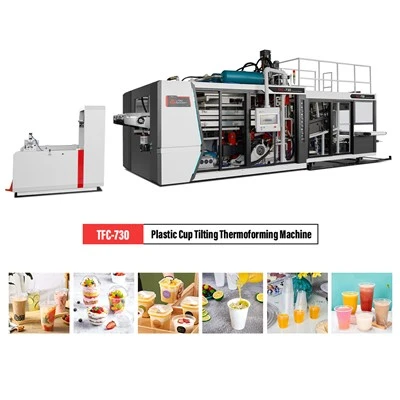
Plastic Glass Making Machine
Read More > -
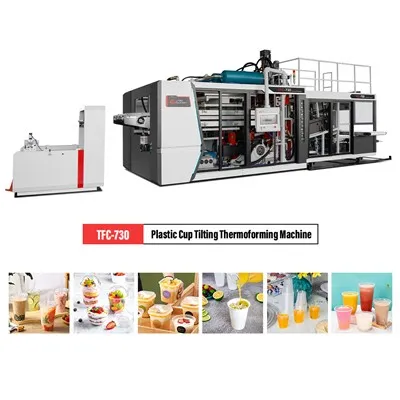
Flip Mold Plastic Thermoforming Cup Machine
Read More > -
Tilt-mold Cup Thermoforming Machine
Read More > -
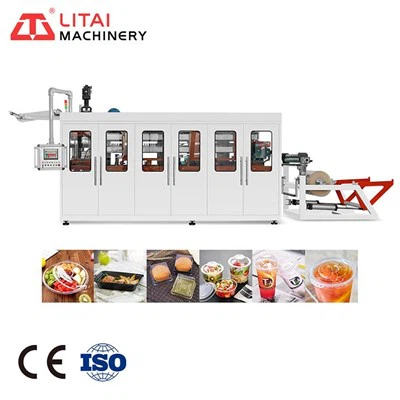
TQC-750 Plastic Cup Thermoforming Machine
Read More >