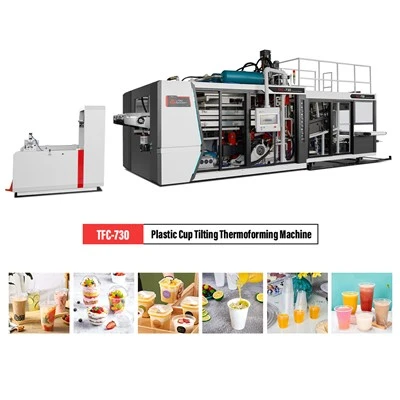
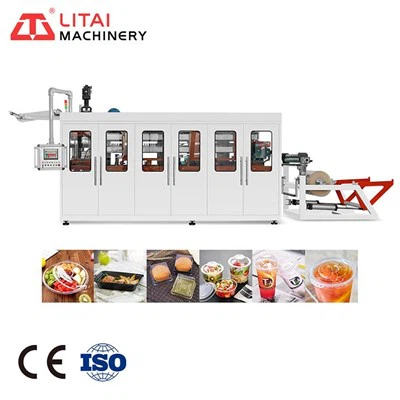
In the modern manufacturing industry, the thermoforming process of cups is regarded as a key link, and its core position is obvious. Thermoforming technology is to shape thermoplastic materials into cups of different shapes and sizes through multiple steps such as heating, forming and cooling. However, in this process, we may encounter various quality challenges, such as deformation, surface defects, dimensional instability and material breakage. Such problems not only have a negative impact on the appearance and function of the product, but may also lead to reduced production efficiency and increased costs. Therefore, it is very important for the manufacturing industry to solve these quality bottlenecks and improve product quality and production efficiency.
What are the manifestations of common deformation problems in the thermoforming process of cups, what are the possible causes, and how to solve them?
1. Manifestations of deformation problems
During the thermoforming stage of cups, deformation problems such as twisting and bending are often encountered. These changes in form not only damage the appearance of the product, but also may lead to a decrease in its performance.
2. Possible causes
The occurrence of deformation problems is often closely related to various factors such as uneven heating, improper mold design and improper cooling methods. Uneven heating may cause uneven temperature distribution of the material during molding, which may cause deformation; if the mold design is inappropriate, the material may be subjected to uneven forces during the molding process, causing deformation; if the cooling method is inappropriate, the molded cup may deform due to different temperatures during cooling.
3. Solution
In order to effectively solve the problem of material deformation, we can consider the following strategies: reconfigure the heating system to ensure that the temperature distribution of the material is balanced during the heating process; optimize the mold design to ensure that the material is subjected to balanced forces during the molding process; in order to ensure that the temperature of the molded cup can drop evenly during cooling, we need to strengthen cooling management.
How do defects (such as scratches, bubbles, scorching, etc.) appear on the surface of thermoformed cups, and what are the effective preventive measures?
1. Causes of defects
Defects on the surface of thermoformed cups, such as scratches, bubbles, scorching, etc., are mainly caused by damage to the mold surface, impurities in the material, and excessive heating temperature. During the molding process, damage to the mold surface may transfer defects to the final product; during the molding process, impurities in the material may produce bubbles or be burned; excessive heating temperature may cause the material to burn.
2. Preventive measures
In order to avoid these defects, we can implement the following strategies: regularly perform necessary maintenance and care on the mold to ensure that its surface is always smooth and intact; we strictly screen the selected materials to ensure that there are no impurities; accurately adjust the heating temperature to prevent excessive temperature from causing burning.
The size of the cup is unstable after thermoforming. How to accurately control the molding size to improve product consistency?
1. Reasons for dimensional instability
Due to mold wear, temperature instability and material fluidity, the size of the cup becomes less stable after thermoforming. Mold wear may cause the molding size to gradually increase or decrease; temperature instability may change the flow characteristics of the material, which in turn affects the molding size; the material fluidity will directly determine the accuracy of the size after molding.
2. Methods for precisely controlling the molding size
In order to more accurately control the molding size, we can implement the following strategies: replace worn molds periodically to ensure the accuracy of the molding size; keep the heating temperature stable to reduce the adverse effects of temperature fluctuations on the fluidity of the material; optimize the material formula to enhance its fluidity and stability.
What are the reasons for the cracking or tearing of the cup material during the thermoforming process, and what methods can be used to enhance the toughness of the material?
1. Reasons for material cracking or tearing
During the thermoforming process, the cup material cracks or tears, which is mainly due to insufficient material strength, improper mold design, and excessive pressure during molding. If the material is not strong enough, it may not be able to withstand external pressure during the molding process, resulting in fracture; if the mold design is inappropriate, it may cause the material to withstand excessive force during the molding process, resulting in tearing; if the molding pressure is too high, the material may be directly fractured.
2. Methods to enhance material toughness
In order to improve the tensile strength of the material, we can implement the following strategies: optimize the material formula and enhance its strength and toughness; optimize the structure of the mold to ensure that the material is subjected to a more balanced force during the molding process; adjust the pressure during molding to prevent excessive pressure from causing the material to break.
How to reduce the occurrence of quality problems and improve production efficiency by optimizing the thermoforming process parameters (such as temperature, time, pressure, etc.)?
1. The importance of optimizing process parameters
In order to improve the quality of products and the benefits of production, it is very important to accurately adjust the thermoforming process parameters. Small fluctuations in process parameters, such as temperature, time and pressure, may have a significant impact on the quality of the final product.
2. Optimization strategy
In order to better adjust the process parameters, we can consider the following methods: use advanced temperature management systems to ensure the stability and accuracy of heating temperature; use high-precision timing tools to ensure accurate management of time during the molding process; by adding a pressure regulator, we can accurately adjust the molding pressure.
3. Practical Cases
After introducing cutting-edge temperature management systems and high-precision timing equipment, a manufacturing company successfully reduced the defective rate of its products by 30% and increased production efficiency by 20%. This example profoundly reveals the key role of optimizing production process parameters in improving product quality and production efficiency.
In the thermoforming process of cups, quality problems often encountered include deformation, surface defects, dimensional instability, and material cracking. In order to meet these challenges, we can consider adopting the following strategies: adjusting the heating system, improving the design of the mold, enhancing the management of cooling, regularly maintaining the mold, strictly screening the materials, accurately controlling the heating temperature and time, and optimizing the material formula. At the same time, continuously optimizing and improving process parameters is also a core factor in improving product quality and production efficiency. Looking to the future, with the continuous advancement of intelligent technology and materials science, we have every reason to believe that quality problems encountered in the thermoforming process of cups will be solved more effectively, thus bringing the manufacturing industry into a brighter development prospect.