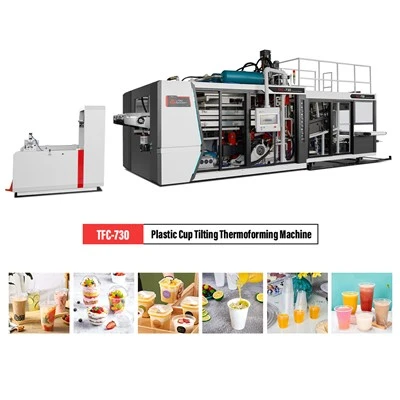
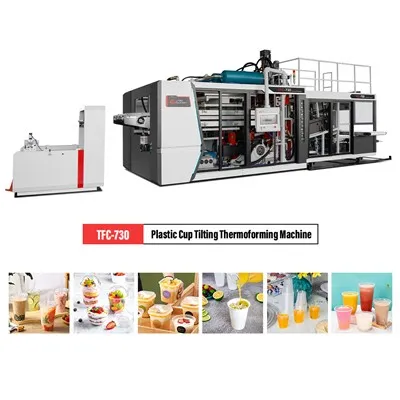
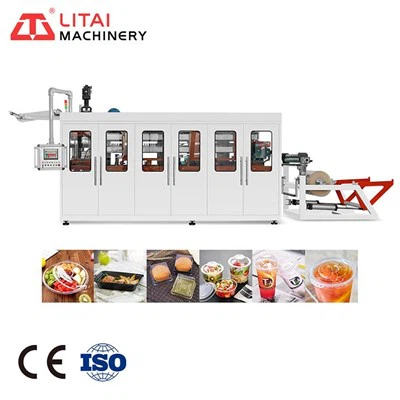
Plastic thermoforming machines, as key equipment in the field of plastic processing, play an indispensable role in many industries. From daily-use packaging containers such as disposable lunch boxes and beverage cups to industrial components like automotive interior parts and appliance housings, plastic thermoforming machines can efficiently and accurately produce compliant plastic products. A thorough understanding of the working principle of plastic thermoforming machines is essential for optimizing production processes, enhancing product quality, and driving technological innovation. This article will conduct a detailed analysis of the operational workflow of plastic thermoforming machines, with a focused examination of the functional mechanisms governing key processes including heating, forming, cooling, positioning and transfer, and demolding.
Working Principle of the Heating Stage in Plastic Thermoforming Machines
Overview of Heating Methods
Thermoforming machines primarily utilize two heating methods: infrared heating and forced convection (hot air) heating.
Infrared Heating: This method employs infrared emitters to generate specific wavelengths of infrared radiation directed at the plastic sheet surface. The sheet absorbs this radiant energy, converting it directly into heat for rapid temperature increase. Infrared heating offers significant advantages in speed and efficiency, making it particularly suitable for high-speed production lines where rapid heating is essential.
Forced Convection (Hot Air) Heating: This technique involves heating air via an element and then circulating it over the plastic sheet using fans. The circulating hot air ensures uniform heat distribution across the sheet. Its key benefit lies in achieving consistent temperature profiles, effectively preventing localized issues like hot spots or insufficient heating. This makes it ideal for processing plastic sheets demanding strict temperature uniformity.
Temperature Control Ranges and Impact on Plastic Sheet
Different types of plastic sheet materials possess distinct optimal forming temperature ranges. For instance, Polystyrene (PS) typically forms best at temperatures between 140°C and 180°C, while Polypropylene (PP) generally requires temperatures ranging from 160°C to 220°C.
Precise temperature control during heating is critical:
Insufficient Temperature: If the temperature is too low, the plastic sheet fails to achieve adequate softening. This leads to problems during forming such as difficulty stretching and incomplete shape definition, resulting in defective parts exhibiting cracks or inconsistent wall thickness.
Excessive Temperature: Overheating causes thermal degradation of the plastic material. This manifests as bubbles, discoloration, and other defects that severely compromise both the quality and functional performance of the final product.
The molding process of the mold and the heated plastic sheet
Mold Design and Structural Characteristics
Mold design is based on the shape, dimensions, and precision requirements of plastic products. The structure typically includes a core, cavity, and auxiliary forming components. The core shapes the internal features of the product, while the cavity defines its external form. Material selection is critical, with high-strength, wear-resistant, and heat-resistant steels (e.g., P20, 718) commonly used to ensure dimensional stability and surface quality during prolonged production. Molds may also incorporate cooling channels and vent slots. Cooling channels accelerate solidification, while vent slots expel gases generated during forming to prevent air bubbles in the final product.
Mold-Plastic Sheet Contact and Pressure Control
Heated plastic sheets are fed between molds, where clamping motion ensures full-surface contact. This uniform pressure allows the sheet to conform precisely to the mold geometry. Pressure regulation is vital: insufficient pressure causes poor mold adhesion, leading to dimensional inaccuracies and uneven wall thickness; excessive pressure risks overstretching or tearing the material. Pressure settings depend on the sheet's material, thickness, and product complexity, controlled precisely via hydraulic or pneumatic systems.
Principles and Techniques for Shaping Specific Forms
Shaping relies on the plasticity of heat-softened plastic. When pressed against the mold under controlled pressure, the sheet plastically deforms into the desired configuration. Key technical parameters include precise management of heating temperature, forming pressure, and cycle time. Mold surface finish directly impacts product aesthetics, necessitating meticulous polishing after machining.
The Role of the Cooling System in the Shaping of Plastic Products
Cooling System Composition and Operating Principle
The cooling system consists primarily of cooling channels, a water pump, a reservoir, and coolant (typically water). The pump circulates coolant from the reservoir through the mold's cooling channels. As the coolant flows, it absorbs heat from both the mold and the plastic product before returning to the reservoir for re-cooling. This cycle rapidly reduces temperatures, enabling efficient solidification of plastic products.
Coolant Selection and Cooling Efficiency Factors
Water serves as the standard coolant due to its high specific heat capacity and thermal conductivity, ensuring rapid heat dissipation. Cooling efficiency depends on three key parameters:
- Flow rate: Higher volumes transfer more heat per unit time.
- Temperature: Lower coolant temperatures increase the thermal gradient, accelerating cooling.
- Flow velocity: Optimized flow velocity ensures adequate dwell time for maximum heat absorption within channels.
Impact of Cooling Duration on Product Quality
Cooling time critically influences product dimensional stability. Insufficient cooling causes premature removal of internally hot parts, leading to warpage and dimensional inaccuracy. Conversely, excessive cooling extends production cycles, reducing throughput. Optimal cooling duration must balance material properties, part thickness, and mold design to ensure dimensional integrity while maintaining production efficiency.
Working Principle of the Mechanism Driving the Movement and Positioning of Plastic Sheets
Sheet Handling Mechanisms and Drive Systems
Sheet transport systems primarily utilize roller-based conveyors or robotic manipulators. Roller systems employ motor-driven rollers that positively advance plastic sheets via friction. This drive method offers simple construction and smooth operation, ideal for continuous production. Robotic manipulators employ gripping mechanisms to position sheets with high accuracy. While delivering superior flexibility and positioning precision, this approach involves more complex engineering and higher costs.
Precision Control and Calibration of Positioning Systems
Positioning accuracy is critical for maintaining correct forming alignment. Common methods include:
- Mechanical positioning: Uses hard stops or locating pins, where precision depends on component machining and installation tolerances.
- Electro-optical positioning: Employs photoelectric sensors to detect sheet position, with control systems executing real-time position compensation based on feedback signals.
Calibration involves adjusting mechanical components and sensor parameters to meet production tolerances.
Technical Measures for Ensuring Forming Position Accuracy
Beyond precision positioning systems, key technical controls include:
- Maintaining consistent transport velocity to prevent positional drift during feeding
- Implementing periodic maintenance and calibration protocols for positioning systems
- Optimizing control algorithms for enhanced signal processing accuracy and real-time response
Working Principle of Demolding Mechanism and the Process of Removing Plastic Products
Ejection Mechanism Types and Structural Features
Ejection systems primarily employ ejector pins, pneumatic ejection, or robotic extraction. Ejector pins physically push finished parts from molds-simple and reliable but may leave witness marks. Pneumatic ejection uses compressed air to blow parts free, offering high speed and minimal surface impact yet requiring air supply infrastructure. Robotic systems grip and remove parts, ideal for complex or fragile geometries while enabling full automation.
Ejection Force Control and Process Safety
Precise ejection force management is critical:
- Insufficient force causes incomplete part release
- Excessive force risks part deformation or damage
- Force requirements depend on material properties, part geometry, dimensions, and mold adhesion. Safety protocols include physical guarding against moving components and scheduled maintenance to ensure operational reliability.
Finished Part Handling and Post-Processing
Part retrieval methods align with ejection mechanisms:
- Ejector/pneumatic systems: Parts drop directly into collection bins
- Robotic systems: Parts are transferred to designated stations
- Post-processing may include flash trimming, quality inspection, and packaging to meet final specifications.
In summary, the working principle of plastic thermoforming machines encompasses several key stages: heating, forming, cooling, positioning/movement, and demolding. Precise control over heating temperature, forming pressure, and cooling time, coupled with well-designed mold structures and ejection mechanisms, enables the production of high-quality plastic products.
Driven by technological advancements, thermoforming machine technology is evolving towards greater efficiency, energy savings, intelligence, and precision. Moving forward, the continuous emergence of new materials and increasingly stringent quality requirements for plastic products will drive the broader application of thermoforming technology across diverse sectors, creating new opportunities for the plastics processing industry.