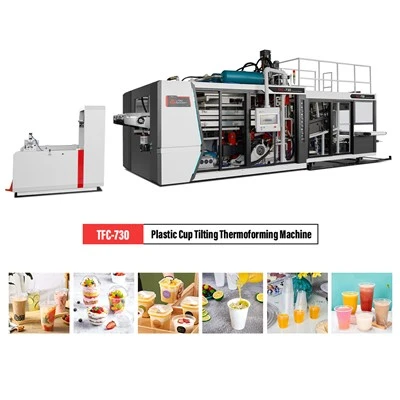
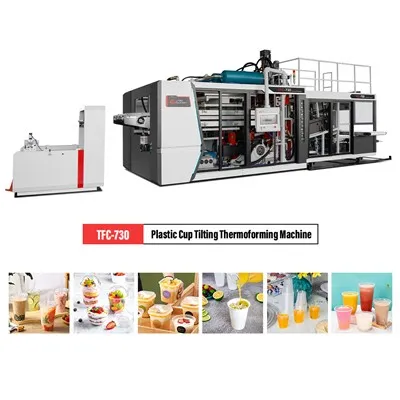
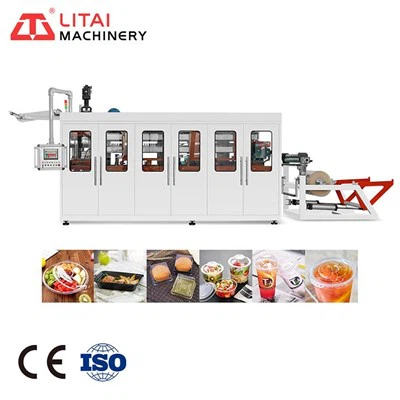
Plastic thermoforming machines play a vital role in today's plastics processing industry. They transform plastic sheets into plastic objects of all shapes and sizes through heating, molding and cooling processes. These machines are widely used in food packaging, grocery manufacturing, electronic and electrical housing production and other fields. With the increasing demand and diversification of plastic products, it is very important to choose the right type of plastic thermoplastic machine. The correct model can not only meet production needs and improve production efficiency, but also ensure product quality and reduce production costs. Therefore, according to the relevant factors, it is important to explore how to select the right plastic thermoforming machine.
Model Selection of a Plastic Thermoforming Machine Model Based on Production Requirements
Production Output Requirements
Production yield is one of the key factors affecting the selection of thermoforming machine. Production is demanding, with large quantities of plastic products produced per unit of time, necessitating the selection of machines with high automation and fast forming speeds. Some large food packaging companies, for example, produce tens of thousands of packaging boxes a day. If manual or semi-automatic thermoforming machines is used, it is not only inefficient, but also labor cost is high, it is difficult to meet the requirements of mass production. In this case, it is recommended to use large, high-speed, fully automated thermal molding machines. These machines are often equipped with advanced automated control systems that automate the entire process from sheet conveying, heating, molding to removal. They can produce dozens or even hundreds of parts a minute, greatly increasing productivity.
Thermoforming machines has different specifications and characteristics for different production range. For low-volume products (e.g., dozens of parts per hour), small manual or semi-automatic thermoforming machines are appropriate because of their simple structure, ease of operation and low cost. Medium ATMs are appropriate for medium-volume products (e.g., hundreds of items per hour) because they have a high degree of automation and meet certain production efficiency requirements. For high-volume products (e.g., thousands of parts per hour), large, high-speed, fully automatic thermoforming machines are essential to ensure continuous, efficient production.
Shaping Size Requirements
The maximum mold size of the product is closely related to the working surface size and mold size of the thermoforming machine. When selecting a a thermoforming machine, the surface of the workpiece should be suitable for the molded product and the mold size should match the surface of the workpiece. For example, if you are producing a large 800mm x 600mm x 100mm plastic tray, the selected thermoforming machine's work surface should have a working surface of at least 800mm x 600mm. Die design should also consider the size and shape of the product.
It is important to select a thermoforming machine that can be adapted to the maximum mold size of the product while allowing a certain profit. This is because, in actual production, product dimensions may vary slightly, or you may need to produce a similar but slightly larger product. If the thermoforming machine's work surface size is exactly equal to the product's maximum mold size, there is no margin, if the size of the product changes, production will not function properly. Therefore, it is generally recommended to choose a a thermoforming machine with a working surface size 10% to 20% larger than the maximum mold size of the product to increase the versatility and flexibility of the machine.
Shaping Precision Requirements
Molding precision directly affects the product quality. High precision molding ensures that product size tolerance is within acceptable range and surface finish is excellent, thus improving the product's appearance and performance. For example, in the process of producing electronic appliance casings, because the size accuracy and surface quality of the casings affect the assembly and use of electronic products, the demand for molding accuracy is very high. Inadequate molding precision will lead to poor coordination between the housing and internal components, affecting product performance and reliability.
The control system and mold manufacturing processes of Thermoforming machines are different for different precision requirements. High-precision thermoforming machines is usually equipped with advanced numerical advanced CNC systems, which can precisely control parameters such as heating temperature, molding pressure, molding time, etc., to ensure stability and accuracy of molding process. In addition, the mold manufacturing process is more refined, using high precision processing equipment and techniques to ensure size accuracy and surface quality. On the other hand, Low-precision thermoforming machines may utilize simpler control systems and mold manufacturing processes, resulting in lower costs, but also lower molding precision.
Selection of the right plastic thermoforming machine model suitable for different production scales
Small-scale production
Small-scale production is usually characterized by small order volumes, large variety of products and high production flexibility requirements. For example, some small handmade plastic processing plants may accept orders of various types and specifications at the same time, perhaps as few as a few dozen to a few hundred items per order. In this case, manual or semi-automatic thermoforming machines recommended.
Manual or semi-automatic thermoforming machines has the advantages of low cost and flexible operation. Their relatively low prices make investment in small businesses relatively low. In addition, the operator can adjust the parameters and operation methods of the machine by hand according to specific product requirements, so that the machine can adapt quickly to the variety of products. For example, when a new plastic product needs to be produced, operators can easily change molds and adjust parameters such as heating temperature and molding pressure without a lot of modification and debugging of the equipment.
Mid scale production
Middle-scale production balances output and product types. It requires a certain level of production efficiency to meet market demand, as well as the ability to produce a variety of products. For example, some medium-sized plastic packaging companies may produce a combination of products, such as food packaging, drug packaging and necessities packaging, from a few hundred to several thousand items per hour.
Automatic thermoforming machines, which is suitable for medium-sized production operation, has the characteristics of moderate automation, high production efficiency and can meet certain product diversity requirements. These machines are generally equipped with automated functions, such as automatic sheet conveying and demolding systems, which reduce manual labour and improve productivity. In addition, mold replacement and parameter adjustment are relatively easy to adapt to the production needs of different products. For example, by replacing molds and adjusting control system parameters, the same machine can produce plastic products of all shapes and sizes.
Mass production
Large-scale production is characterized by high output, continuous production and high consistency in product quality. For example, large food packaging companies and car upholstery manufacturers produce large quantities of plastic products every day and require stable product quality to ensure their market competitiveness.
It is recommended Large-scale, high-speed, fully automatic thermoforming machines. These machines have significant advantages in productivity, quality control and integrated automation. Its superior production efficiency allows it to produce dozens or even hundreds of parts per minute, satisfying the need for mass production. It is equipped with advanced quality control control system, such as on-line inspection device and automatic adjustment system, so as to monitor product quality in real time, adjust equipment parameters in time and ensure the consistency of product quality. In addition, the large, high-speed, fully automatic thermoforming machine is characterized by a high degree of automation, which combines various processes such as sheet conveying, heating, molding, cooling and disassembly. This reduces manual intervention and improves continuity and reliability of production.
Selection of Plastic Thermoforming Machine Models Based on Product Material and Characteristics
Classification and Characterization of Common Plastic Materials
Common plastic materials are polyethylene (PE), polypropylene (PP), polystyrene (PS) and polyvinyl chloride (PVC). Polyethylene has excellent chemical stability, low temperature resistance and electrical insulation properties. It is commonly used in the manufacture of plastic films and containers. It has a low melting point, typically between 100°C and 130°C, and is fluid but shrinks significantly. Polypropylene is characterized by high strength, rigidity and heat resistance, with melting point between 160°C and 170°C. It exhibits relatively little fluidity but minimal contraction, making it commonly used to make car parts and electrical casings. Polystyrene has excellent transparency, processing performance and insulation properties. It has a melting point of between 80°C and 100°C and is liquid but relatively fragile. It is commonly used to make disposable tableware and toys. Polyvinyl chloride (PVC) has excellent flame retardancy, chemical resistance and electrical insulation. According to the plasticizer used, it can be divided into rigid PVC and flexible PVC. Rigid PVC has a melting point between 180°C and 200°C, while flexible PVC has a lower melting point and is commonly used in the manufacture of pipes, cable sheathing and other products.
Requirements of different materials for Thermoforming Machine Requirements
Differences in heating temperature, molding pressure and cooling time of different plastic materials have a great influence on the parameters of thermoforming machines. Polyethylene, for example, has a low melting point, so the heating temperature is generally controlled between 120 and 140 degrees Celsius, the molding pressure is relatively low and the cooling time is short. Polypropylene, on the other hand, has a high melting point, a heating temperature of 170-190 degrees Celsius, a relatively high molding pressure and a relatively long cooling time.
Thermoforming machine components need to be adapted to different materials. Precise control of the heating plate temperature, for example, is crucial for molding quality. For temperature-sensitive plastics such as polystyrene, precise control of the temperature of the heating plate temperature is essential, usually within ±2°C, to prevent material from breaking down due to excessive temperature or forming defects due to low temperature. Mold material selection is also critical. For plastics that require high hardness and abrasion resistance, such as polypropylene, choose mold materials with high hardness and abrasion resistance, such as steel, to ensure mold life and molding quality.
Effect of Product Characteristics on Type of Thermal Molding Machine
The complexity of product shape, uniformity of wall thickness, and the particularity of structure (such as rib and protrusion) are important requirements for the design and molding processes of thermoforming machine. For example, for complex products, more complex mold design are required, using multi-cavity or combination molds to improve production efficiency and product quality. In addition, molding process need to be adjusted, such as segmented heating and molding methods, to ensure that all parts of the product are properly molded.
The uniformity of wall thickness also has a great impact on product performance. Uneven wall thickness can lead to stress concentration and deformation during use. Therefore, in the process of hot molding, it is necessary to adjust the molding pressure, cooling time and other parameters to optimize mold design and ensure uniform wall thickness.
For products with special features, such as ribs and protrusions, thermoforming machines must have an appropriate molding capabilities. For example, mold design requires cavities and cores that match a particular structure. In addition, specialized molding methods, such as localized pressurization and secondary molding, may be required to ensure accurate molding characteristics. Therefore, it is very important to choose a thermoforming machine model which meets the characteristics of specific products.
Conclusion:
In summary, according to the production requirements, production scale, product material material properties other factors, the selection of the appropriate plastic thermoforming machine model. In terms of production requirements, we should select the machine with the appropriate automation degree and molding speed according to production volume to ensure that the molded dimensions meets product requirements and has a certain profit margin. According to the required molding accuracy, the appropriate control system and mold manufacturing process should be selected. In terms of production scales, manual or semi-automatic thermostats are suitable for small-scale production, automatic thermoforming machines are suitable for medium-sized production, and large-scale, high-speed, fully automatic thermoforming machines are suitable for large-scale production. It is important to understand the characteristics of commonly used plastics and the requirements of these materials for thermoforming machines in terms of the materials and properties of the products. According to the complexity of product shape, uniformity of wall thickness and specific structural characteristics, a suitable type of thermoforming machine should be selected.
Rational selection of hot a thermoforming machine model is very important to improve production efficiency, ensure product quality and reduce production cost. The correct model can simplify production process, reduce equipment failures and downtime, and improve production efficiency. It can also guarantee product size accuracy and surface quality, and improve product quality. It also reduces production costs and avoids waste of resources and cost increases due to poor equipment selection. Therefore, when choosing a plastic thermoforming machine model, enterprises should carry out adequate research and analysis and make reasonable and informed choices according to their own production needs and actual situation.